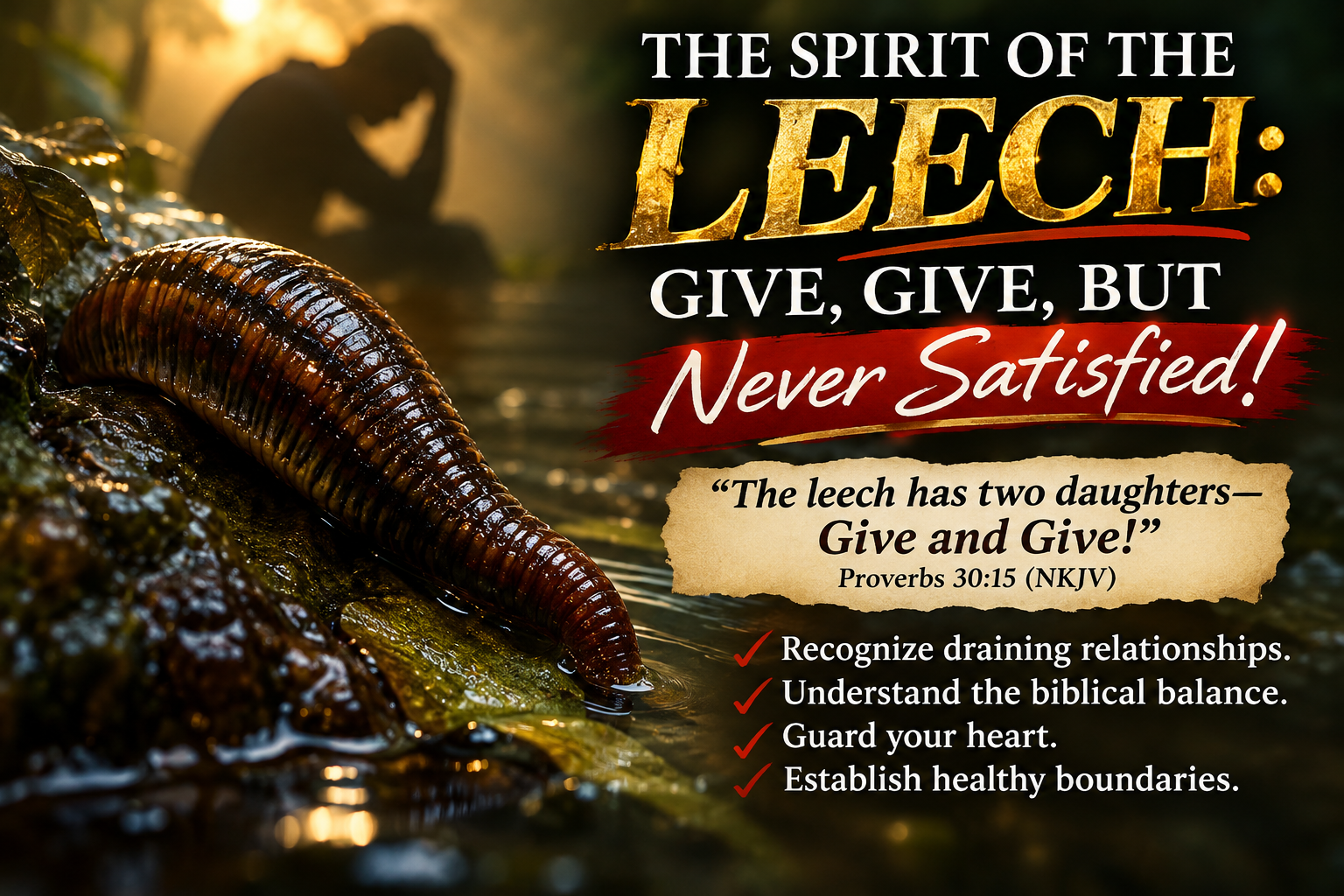
“The leech has two daughters—Give and Give!” — Proverbs 30:15 (NKJV)
The Nature of a Leech
There’s a powerful lesson we can learn from one of nature’s smallest creatures: the leech.
A leech survives by attaching itself to a host and drawing blood. It releases an anticoagulant that helps keep the blood flowing while it feeds.
Think about that for a moment.
The leech doesn’t have to attack violently. It doesn’t have to make a lot of noise. It simply attaches itself and begins to draw from its host.
And if we’re not careful, we can encounter people who demonstrate similar patterns in our relationships.
Some people attach themselves to your kindness, generosity, resources, influence, emotional strength, and even your calling.
They may not consciously intend to destroy you. Nevertheless, their repeated demands can gradually deplete you.
Here’s the revelation: A leech doesn’t have to kill you to weaken you. It only has to keep draining you!
Give! Give! But Never Satisfied
Proverbs 30:15 provides an interesting picture of an appetite that is never satisfied.
“The leech has two daughters—Give and Give!”
Notice the language: GIVE! GIVE!
There’s no mention of gratitude, responsibility, or satisfaction. The imagery is one of continual consumption.
Now, consider how this can manifest in relationships.
Some people continually demand your time but rarely respect your schedule.
Some constantly seek financial assistance but refuse to develop responsible financial habits.
Others repeatedly draw on your emotional strength while showing little concern for your well-being.
And some become so dependent on your generosity that they begin to treat your kindness as an obligation rather than a gift.
What began as an opportunity to help someone can gradually become an unhealthy pattern of dependency.
The danger isn’t always in what someone takes from you at once. Sometimes it’s in what they continually take from you over time.
Connected to Your Purpose or Your Provision?
One of the greatest challenges in relationships is discerning why people are connected to us.
Some people genuinely appreciate who you are, what you carry, and what God has called you to accomplish.
Others may be more interested in what they can receive from you.
There’s a significant difference.
Some people are connected to your PURPOSE, while others are only connected to your PROVISION.
Some come alongside you to help carry the weight.
Others continually add to the weight you’re already carrying.
Some celebrate your growth and encourage your assignment.
Others become uncomfortable when your growth requires boundaries that limit their access to you.
This is why discernment is essential.
Not everyone who needs your help is taking advantage of you. People experience genuine hardship, and Scripture clearly calls us to compassion.
However, we must learn to recognize the difference between someone going through a difficult season and someone developing a lifestyle of unhealthy dependence.
The Biblical Balance Between Compassion and Responsibility
The Bible teaches us to help others, but it also teaches personal responsibility.
Galatians 6:2 says:
“Bear one another’s burdens, and so fulfill the law of Christ.” (NKJV)
Yet only a few verses later, Galatians 6:5 says:
“For each one shall bear his own load.” (NKJV)
At first glance, these verses might appear contradictory, but together they reveal an important principle.
We are called to help one another carry burdens that become too heavy to bear alone. At the same time, each person must accept responsibility for what God has entrusted to them.
Compassion should not automatically become enabling.
Generosity should not eliminate accountability.
And helping someone should not require abandoning your own God-given responsibilities.
There is a difference between helping someone get back on their feet and becoming the feet they refuse to stand on.
Guard Your Heart and Protect Your Assignment
Proverbs 4:23 declares:
“Keep your heart with all diligence, For out of it spring the issues of life.” (NKJV)
Guarding your heart isn’t about becoming selfish, suspicious, or unwilling to help others.
It’s about recognizing that your emotional, spiritual, physical, and financial resources require wise stewardship.
You cannot continually pour into others while neglecting what God has entrusted to you.
Your peace matters.
Your family matters.
Your health matters.
Your purpose matters.
And the assignment God has placed on your life matters.
Even Jesus demonstrated the importance of boundaries. In Luke 5:15–16, as the crowds gathered to hear Him and receive healing, He regularly withdrew into the wilderness to pray.
He didn’t allow the demands of the crowd to replace His communion with the Father.
If Jesus made room for withdrawal and spiritual renewal, how much more should we recognize the importance of protecting our time and spiritual well-being?
Being available to everyone doesn’t necessarily mean you’re being obedient to God.
Sometimes wisdom requires knowing when to give, when to rest, when to establish boundaries, and when to say no.
Don’t Confuse Being Needed With Being Valued
Here’s something worth considering.
DON’T CONFUSE BEING NEEDED WITH BEING VALUED.
A leech needs you, but that doesn’t mean it loves you.
Someone can depend on what you provide without genuinely appreciating who you are.
Someone can desire access to your resources without respecting your boundaries.
And someone can become accustomed to your generosity without ever developing gratitude.
True relationships should not be defined solely by what one person can extract from another.
Healthy relationships involve mutual respect, consideration, accountability, and genuine concern for each other’s well-being.
This doesn’t mean every relationship will involve equal giving at every moment. There will be seasons when one person needs more support than another.
But over time, the character of the relationship becomes evident.
Ask yourself:
- Does this relationship consistently strengthen or deplete me?
- Does this person respect my boundaries?
- Is there genuine gratitude and accountability?
- Am I helping this person grow, or am I unintentionally sustaining unhealthy dependence?
- Is this connection supporting or distracting me from what God has called me to do?
These questions aren’t intended to condemn people. They’re meant to encourage wisdom and discernment.
Final Thoughts: Discernment Is Part of Stewardship
As believers, we are called to love generously, serve compassionately, and give cheerfully.
But love and wisdom are not enemies.
You can love someone and still establish boundaries.
You can forgive someone without continually exposing yourself to the same unhealthy behavior.
You can care about someone’s circumstances without assuming responsibility for every decision they make.
And you can be generous without allowing your generosity to become a source of personal depletion.
Remember:
Some people come to help you carry the weight, while others come to consume your strength. You must have the discernment to know the difference.
Don’t allow guilt to convince you that healthy boundaries are a lack of love.
Sometimes the most loving thing you can do is stop enabling a pattern that prevents someone from growing.
And sometimes protecting your assignment requires limiting access to people who continually drain the resources God has entrusted to you.
Not everyone who is attached to you is assigned to you.
Be generous. Be compassionate. Be discerning.
And above all, be a faithful steward of what God has placed in your hands.
A Nugget to Remember
“A leech doesn’t have to kill you to weaken you. It only has to keep draining you. Don’t confuse being needed with being valued. Not everyone who is attached to you is assigned to you.”
— Quamon Fowler
Nourishing the Soul Through Music and the Message
Nuggets from the Journey | Fort Worth Saxophonist & Live Jazz
More Nuggets from the Journey
Comments
Loading comments…